
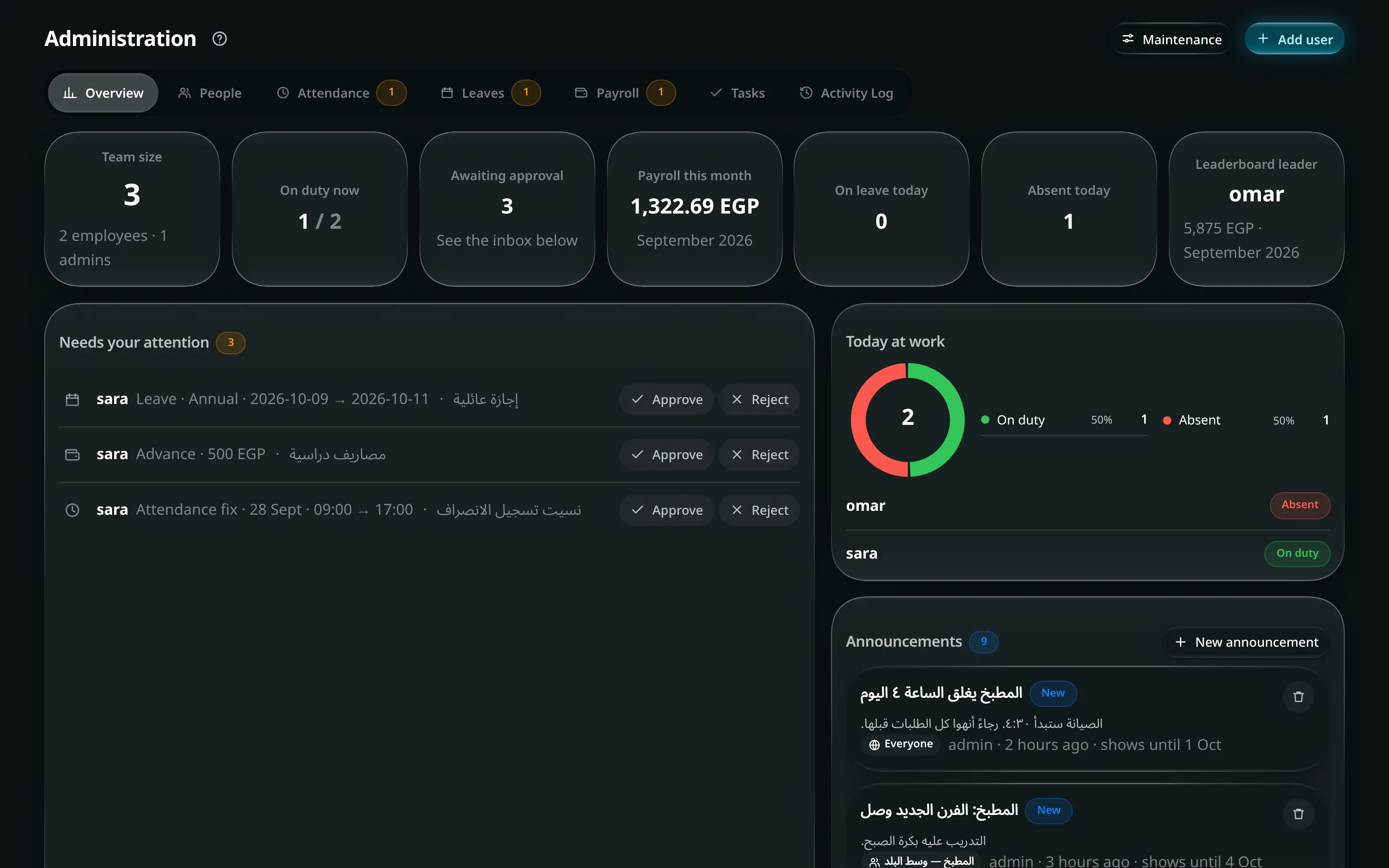
Payroll goes wrong in the same way everywhere: attendance lives in one place, deductions in someone’s head, advances on a piece of paper, and the three are reconciled once a month from memory under time pressure.
Here they are the same record, so the month adds up before you open it.
Set the rules once
Before the first payroll, set — per branch if they differ:
- Shift times, so lateness has something to be late against.
- A grace period. Five or ten minutes. Without one, you are deducting for traffic, and staff learn the system is not on their side.
- The lateness rule: what a late arrival costs, and after how many minutes.
- The absence rule, and what counts as an excused absence.
Set them once and they apply consistently. The value is not the deduction — it is that nobody argues about it, because it was the same rule last week.
Attendance is the source
Staff check in and out. The record shows the shift, the actual times, and the lateness the rules produce. Corrections are possible and logged as corrections — an edited attendance record shows who edited it and when, which is what keeps the number trustworthy.
What feeds the run
A payroll run gathers, per person:
- Base salary for the period.
- Deductions produced by the lateness and absence rules.
- Approved leave, paid or unpaid.
- Salary advances already taken, which is the line most shops lose.
- Any manual adjustment you add, with a reason.
Nothing here is typed twice. Each figure is the consequence of something that was recorded when it happened.
Review, then approve
The run is a draft until you approve it. Read it against what you remember of the month — if a number surprises you, the record behind it is one tap away, and usually the surprise is real information: a shift nobody was scheduled for, or an advance you had forgotten.
Approving books the payments into the cash registry like any other money leaving the business, and produces payslips that print.
What staff can see
Employees do not see profit, cost prices, other people’s pay, or the full cash registry. They see their own attendance, their own leave and advance requests, and their own payslip.
If you want to check exactly what your team sees before rolling something out, switch into the employee view — an admin can, and it is the fastest way to find out that a screen you assumed was hidden is not.