
Two requests make up most of what a shop owner is asked in a month: time off, and money before payday. Both are usually handled by WhatsApp and remembered badly.
One queue
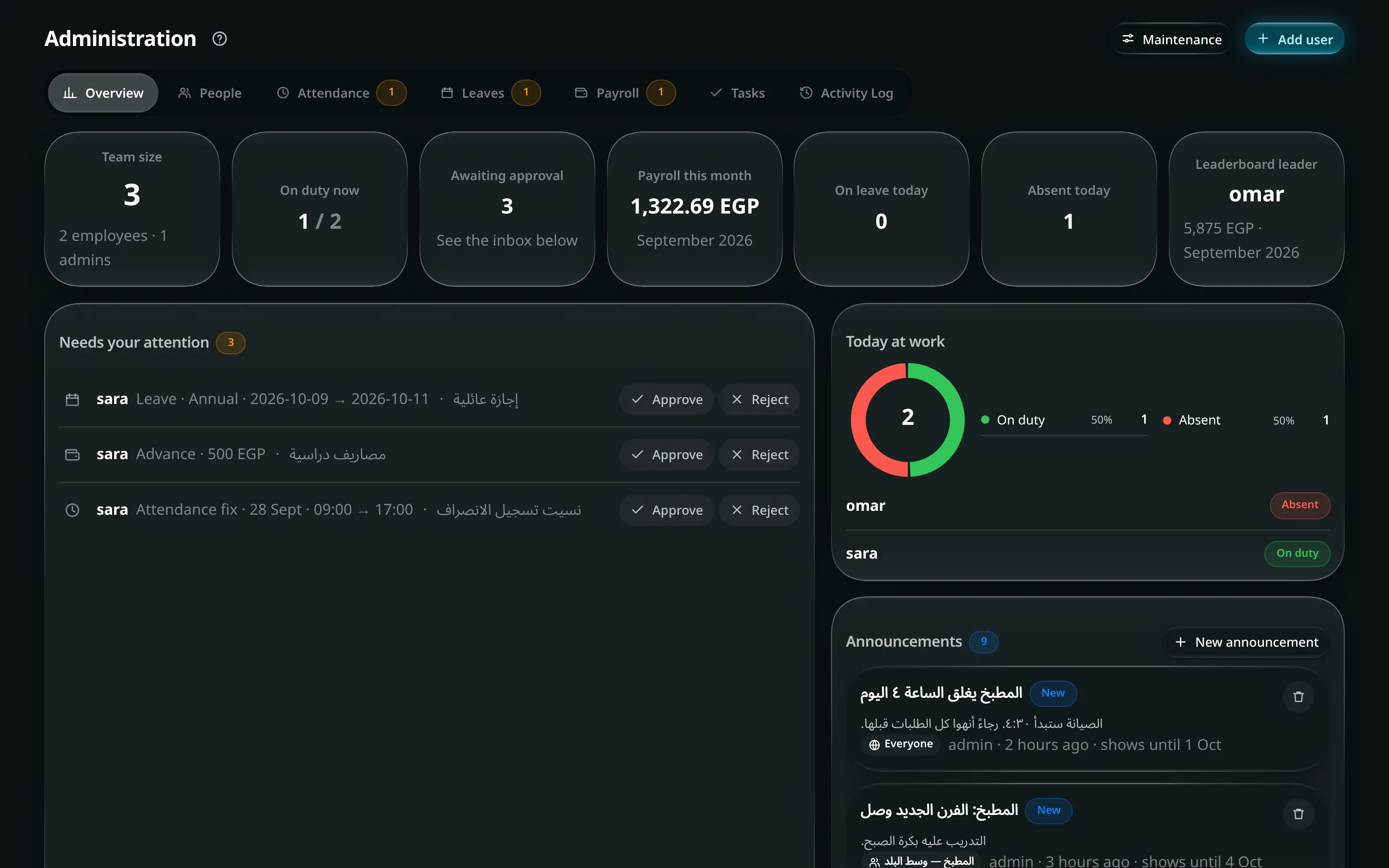
Leave and advance requests land in the same approval queue, and that queue is on the home screen. Not in a menu — on the screen you already open.
That placement is the whole design. A request in a queue nobody visits is a request that gets answered in person three days later, at which point the approval exists only as a conversation.
Leave
A request carries the dates, the type, and a reason. Approving it:
- blocks the dates against that person, so they do not appear as an unexplained absence in attendance;
- feeds payroll as paid or unpaid leave, whichever the type says;
- is logged against the person who approved it.
Refusing it records that too, with the reason. “I never asked” and “I never approved that” are both settled by the same record.
Advances
An advance is money paid before it is earned, and it goes wrong in one specific way: it is paid from the drawer and then not deducted, because the person doing payroll three weeks later does not know it happened.
Here, approving an advance:
- books the payment out of the cash registry, so the drawer balances tonight;
- records the amount against that person;
- is deducted automatically in the next payroll run.
Nothing has to be remembered. The line appears in the run whether or not anybody mentions it.
A limit worth setting
Decide in advance what an advance can be — a fraction of monthly salary, or a fixed ceiling — and apply it consistently. The point is not to be strict; it is that a policy applied to everyone is not a favour, and does not become one.
The activity log
Every approval, refusal and correction is written to the activity log against the person who did it. The log renders each entry in the reader’s language — so an Arabic-speaking manager reads an entry written by an English-speaking colleague in Arabic, and neither of them had to think about it.
That is what makes “who approved this” a question with an answer rather than an argument.