
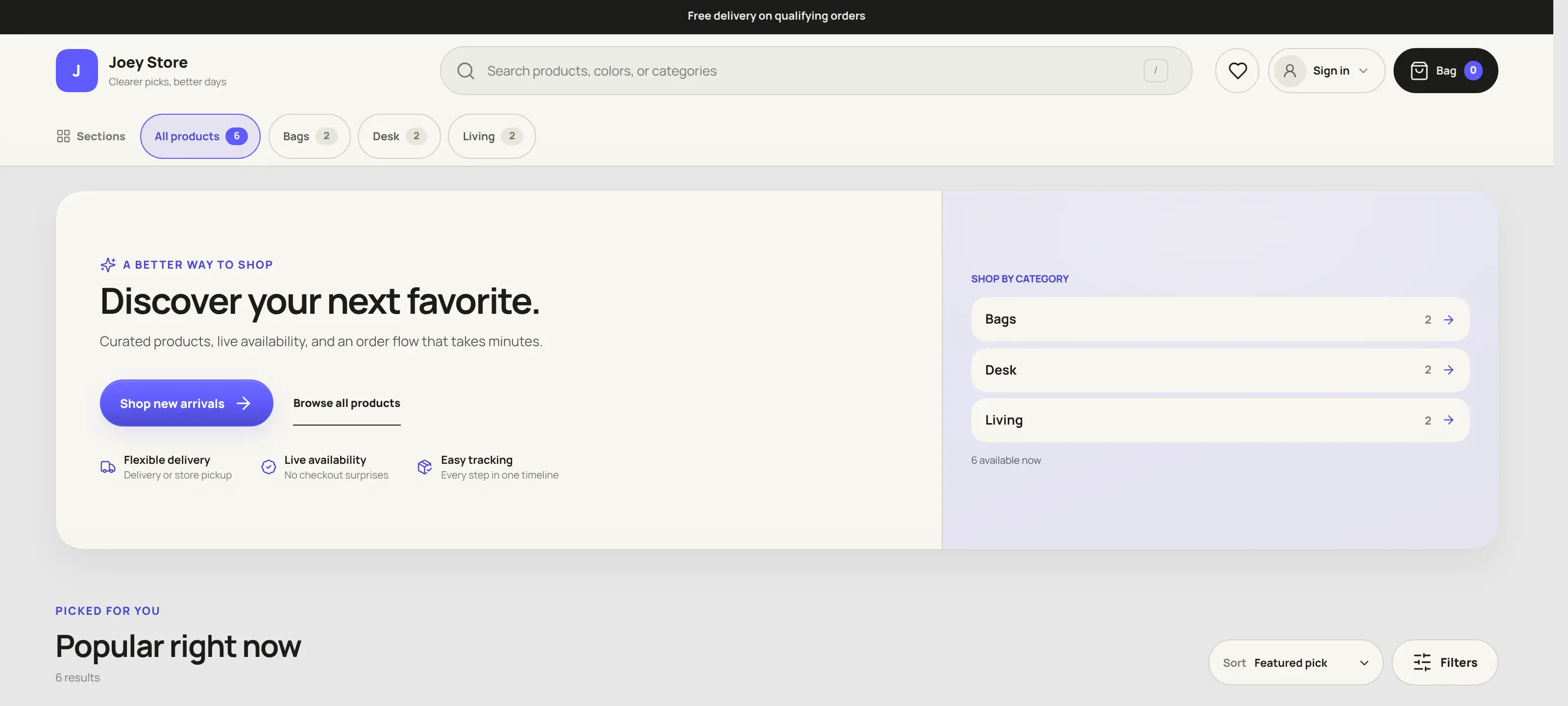
Most shops end up with a website that has its own product list, its own stock numbers and its own idea of who their customers are. Then they spend a year reconciling the two, and eventually stop trusting the website’s numbers.
This storefront reads the same database your counter does. A sale in the shop reduces the stock the website is showing, immediately, because they are the same number.
What to do before you open it
- Decide what is online. Not everything should be. Each product has a visibility flag; start with the things you are happy to sell to someone you have never met.
- Photograph them properly. This is the part shops skip and the part customers judge. Plain background, consistent framing, the actual item.
- Check the variants. A product that sells online in three sizes needs three variants with their own stock, not one with a note.
- Set delivery pricing per area. Shipping is chosen server-side from the customer’s city, so what a customer is quoted is what you configured — not something the browser worked out and could be edited.
Orders arrive in the same pipeline
An online order is an order. It appears in the same pipeline as everything taken at the counter, with the same statuses, the same delivery dates and the same courier settlement. There is no separate “web orders” screen to forget to check.
Payment proof, reviewed in one place
Customers upload a transfer screenshot the same way you do for your own subscription, and you review it in the same queue as everything else. Coupons are validated on the server, never in the browser — a discount code cannot be guessed, edited or reused past its limit by anyone reading the page source.
The things that quietly earn money
- A cart that follows the customer. Signed in on a phone at lunch, finished on a laptop in the evening. Most storefronts lose that sale.
- Abandoned carts you can see. A list of people who got as far as a cart and stopped, which is the warmest list you will ever have.
- Restock requests. Someone wanting a sold-out item tells you so, instead of leaving silently.
- Reviews with moderation. Real ones, published when you approve them.
Wholesale, if you sell to trade
There is a separate portal for resellers, with trade pricing and credit terms on the same customer record. A wholesale customer sees their prices; a retail customer sees yours. One catalogue, two audiences, no second website.
After you open
Watch three numbers in the first month: how many carts are abandoned at the delivery step (usually a pricing surprise), which products get restock requests (what to buy), and how many orders arrive outside shop hours (what the storefront is actually earning you).